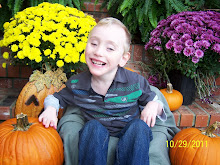
My day was made yesterday by 2 of the most ordinary things.
I went shopping with Christian and bought him "cool", casual shoes at Children's Place and stylish sunglasses. No big deal huh? Wrong..big deal , very big deal. First of all most shoes don't fit over his braces that he wears on his feet. Therefore we have one pair of tennis shoes we wear with everything. I have been wanting some more dressy stylish shoes for his nicer clothes/church/school. Today I hit the jackpot. I was sooooo excited when they fit over his braces...it really made me giddy. Then score number 2 were the sunglasses. He looked like a 6 yr old having fun, wearing his sunglasses on a bright day. The best part was that he didn't try to take them off. I actually wanted to just stroll around some more outside just to get to watch him with his sunglasses on. He actually wore them. It was one of those days where all the stars aligned:)
As much as major things like-taking more steps and learning a new sign-are monumental and obviously exciting....the small things that make me feel like a mom of a typical 6 yr old boy are even grander on certain days. Most of the moms I am friends with experience this same thing. We long for our kids to meet therapy goals that lead them to more independence but we also long for and celebrate the "normalcy" of cool shoes that fit, swimming independently with other kids in the pool, clapping at a performance (when it's actually appropriate time to clap:) dancing in the car to Carly Rae jepsen, watching cartoons on TV, rolling a ball to and laughing with your twin brother,riding rides at SDC....(these are all from real mom's lives).
it's the small things...that are really big things

THE ROLE OF HBOT IN CEREBRAL PALSY
Cerebral Palsy (CP) is a descriptive neurological and physical problem originating from defects in motor cortices. Collectively these are labeled as cerebral palsy.Cerebral Palsy is non-progressive, non-contagious, permanent neurological abnormality. The location and size of the lesion will determine what deficit the child will have. The abnormalities occur in utero, during or after birth up until age five. The affected individual is influenced by genetic and environmental factors as well. Cerebral Palsy is associated with a perinatal hypoxic event (tight nuchal or prolapsed cord), placental abnormalities , prolonged labor, or infection transmitted during delivery.
There is no known cure for cerebral palsy, and there is no standard therapy. Early treatment gives a child a better chance to overcome disabilities.
Two alternative therapies considered by some to be controversial include neuromuscular electrical stimulation and hyperbaric oxygen therapy (HBOT). HBOT might be beneficial in treating Cerebral Palsy cases that are due to traumatic brain injury caused by decreased oxygen.
The theoretical basis for HBOT in CP is that there are areas in the brain next to the CP lesions that are hypoxic due to marginal tissue perfusion. HBOT can increase the available oxygen to these marginal tissues and reactivate the cells to become functional. The number of cells that can be “salvaged” by HBOT cannot be determined. HBOT might cause improvement in motor skills, attention span, visual and verbal commands.
For this treatment, HBOT is used at “low pressure” (1.5 to 1.7 atmospheres absolute), as this has been demonstrated to be optimal pressure that an injured brain can tolerate without toxicity.